HOME
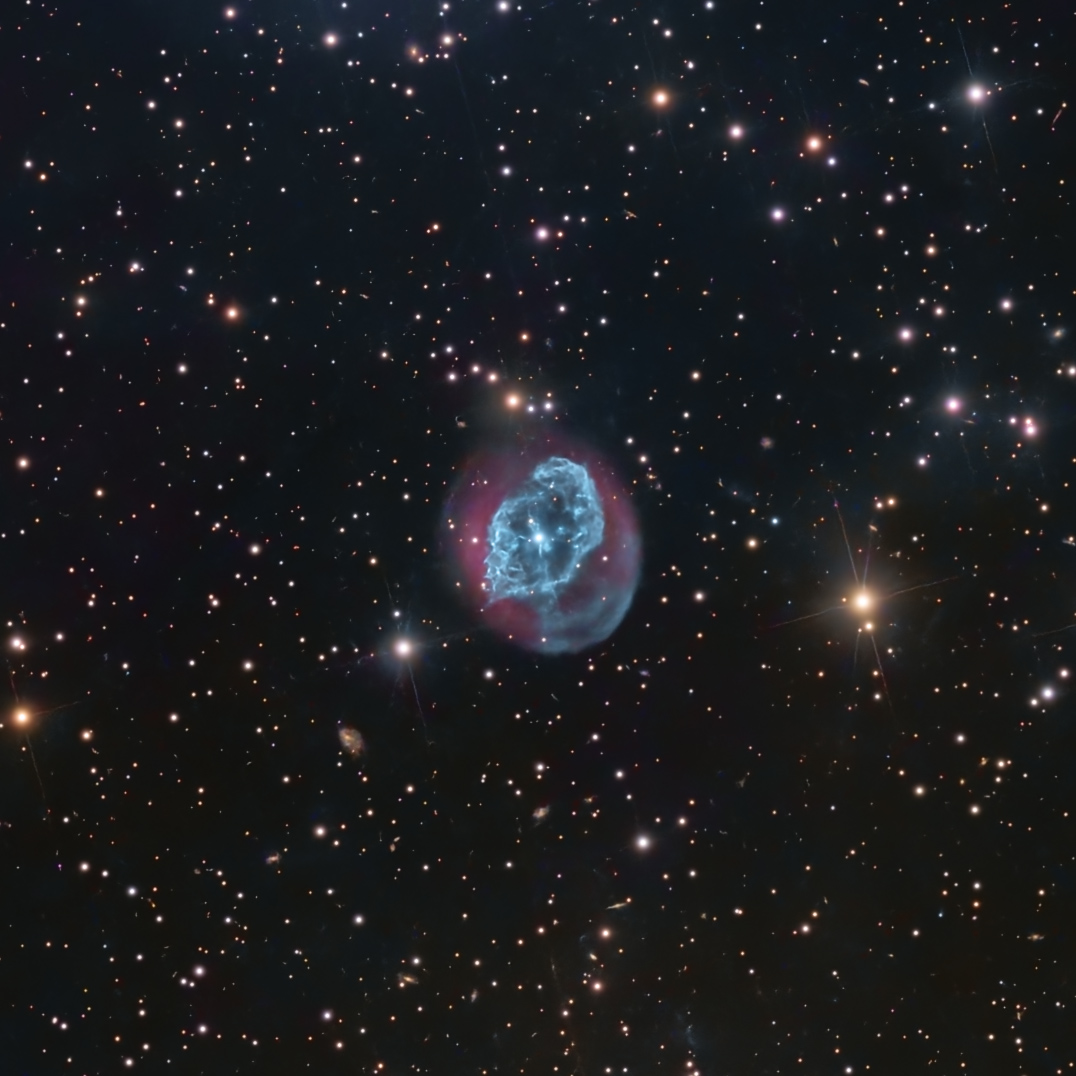
Abell 78
Abell 78
Born-Again Planetary Nebula in Cygnus

Click here for uncropped versions: 100% uncropped (4076x4076) 65% uncropped (2649x2649) 40% uncropped (1630x1630)
Click on image to cycle through the three versions: Full resolution, cropped; 1.5X upsampled, and 2X upsampled.

Abell 78 is a small, fairly obscure (seldom imaged) planetary nebula, visually located in the constellation Cygnus.

This is an unusual "born-again" planetary nebula. After the initial puffing out of the outer layers (which created the round, dim outer layers of this nebula), something odd happened here.

Although fusion of hydrogen into helium had ceased in the core of the dying star, causing it to collapse under its own weight and its envelope to expand into a bubble, some of the star’s outer layers became so dense that fusion of helium resumed there. The renewed nuclear activity triggered another, much faster wind, blowing more material away. The interplay between old and new outflows has shaped the cloud’s complex structure, including the radial filaments that can be seen streaming from the collapsing star at the centre.

This pretty nebula is thought to be about 5000 light years from us, and covers about 2.5 arcminutes of the sky; at that distance, Abell 78 is about 3.6 light years across.

There are about thousands of stars in the uncropped field, which is slightly larger than a full moon; there are a lot of stars in the sky that we don't see! There are also a LOT of galaxies in the background of the uncropped versions, many showing some structure.

The blue light bleeding into the cropped frame is from a very bright blue star just above the cropped frame; it's very evident in the uncropped frame.


Technical Information:

(HaL)(HaR)(OIIIG)(OIIIB): Ha:OIII:L:R:G:B: 750:630:567:135:180:240 (a total of almost 42 hours of light-frame exposure time); here's a chart showing the various subexposures I used in the image:

Hydrogen Alpha: 25 thirty-minute
Oxygen III: 21 thirty-minute
Luminance: 34 fifteen-minute, and 19 three-minute
Red: 9 fifteen-minute
Green: 12 fifteen-minute
Blue: 12 twenty-minute
The luminance layer of the top image is a mix of the luminance-filtered images and the OIII-filtered images; the red channel is a mix of the red-filtered images and the Ha-filtered images; the green channel is a mix of the green- filtered images and the OIII-filtered images; the blue channel is a mix of the blue-filtered images and the OIII-filtered images.


Equipment: RC Optical Systems 14.5 inch Ritchey-Chrétien carbon fiber truss telescope, with ion-milled optics and RCOS field flattener, at about f/9, and an SBIG STX-16803 with internal filter wheel (SBIG filter set), guided by an SBIG AO-X/STX Guider, all riding on a Bisque Paramount ME German Equatorial Mount.

Image Acquisition/Camera Control: Maxim DL, controlled with ACP Expert/Scheduler, working in concert with TheSky X.

Processing: All images calibrated (darks, bias and sky flats), aligned, and combined (using NormalizeScaleGradient) in Pixinsight. Color combine in Pixinsight. Narrow-band data blended into the luminance and color layers in Pixinsight. Some finish work (gradient correction, background neutralization, color calibration, NoiseXTerminator, BlurXTerminator, done in Pixinsight; some finish work (LRGB combination, saturation adjustment) was done in Photoshop CC.

Location: Data acquired remotely from Sierra Remote Observatories, Auberry, California, USA.

Date: Images taken on many nights during August and September of 2025. Image posted January 6, 2026.

Date: Image scale of full-resolution image: 0.56 arcseconds per pixel.

Seeing: Variable; often good, but often not at all good.

CCD Chip temperature: -25C

Copyright 2025, 2026 Mark de Regt

hosting forum
Hit Counter