HOME
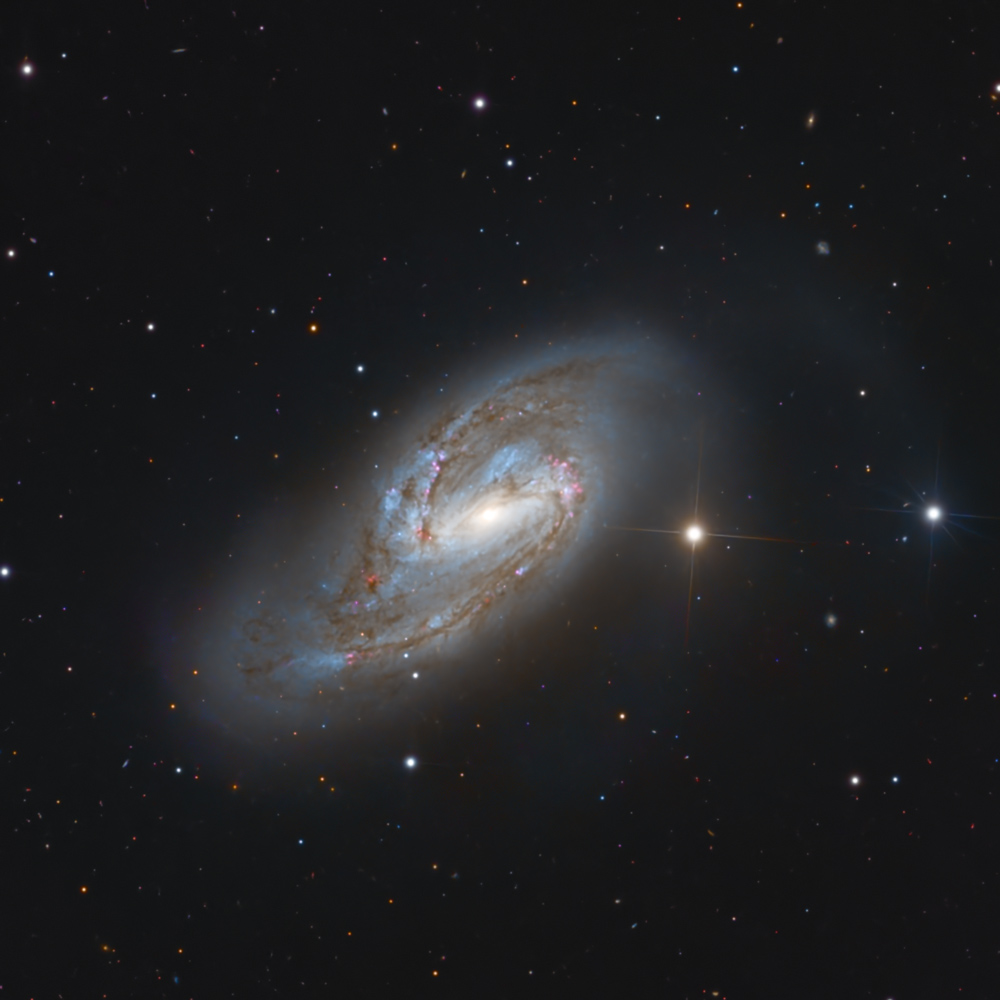
M66
M66
NGC 3627
Intermediate Spiral Galaxy in Leo

Click here for different versions:  Full Resolution (1576x1592)  Both Galaxies, Full Frame, 50% (2048x2048) Both Galaxies, 100% (4096x4096)


M66 is a large spiral galaxy, with a weak bar, presenting to us at a significant angle (causing the elliptical appearance). It is located near two other large galaxies M65 and NGC 3628); the tidal forces from the gravitational interactions among those three massive galaxies has resulted in noticeable distortion in two of the three. The three galaxies can be seen together in this photo I took years ago of the so-called Leo Trio. M66 is estimated to be about 36 million light years away from us; at that distance, it is about 95,000 light years in diameter (a bit smaller than our Milky Way, but still a large galaxy). I imaged M65 at the same time, in the same frame, as M66; you can see it here; there also is a link above the photo above to a couple of images showing both M65 and M66 in the same image. I had imaged NGC 3628 a couple of years earlier; it is here.

M66 shows some effects of its past interactions with its neighbor(s). It's nucleus has an unusually high density, and we can see the tidal tails swirling around the galaxy (the dustlike, dim matter around the galaxy, which mostly consists of stars ripped from the arms of the galaxy by gravity.

As usual in a deep-sky image, there are a lot of small (meaning distant) galaxies in the uncropped versions of the image (look for the oblong and/or fuzzy "stars").


Technical Information:

Ha:L:R:G:B: 440:540:180:210:240 (a total of almost 27 hours of light-frame exposure time); here's a chart showing the various subexposures I took:
Luminance: 32 fifteen-minute and 20 three-minute
Red: 12 fifteen-minute
Green: 14 fifteen-minute
Blue: 12 twenty-minute
Ha: 22 twenty-minute

Luminance layer is a blend of the two sets of luminance-filtered images.
Red is a blend of the red-filtered images and the Ha-filtered images.
Green is entirely the green-filtered images.
Blue is entirely the blue-filtered images.
.

Equipment: RC Optical Systems 14.5 inch Ritchey-Chretien carbon fiber truss telescope, with ion-milled optics and RCOS field flattener, at about f/9, and an SBIG STX-16803 camera with internal filter wheel (SBIG filter set), guided by an SBIG STX-Guider, all riding on a Bisque Paramount ME German Equatorial Mount.

Image Acquisition/Camera Control: Maxim DL, controlled with ACP Expert/Scheduler, working in concert with TheSky X.

Processing: All images calibrated (darks, bias and sky flats), aligned and combined in Pixinsight. Color combine in Pixinsight. Some finish work (background neutralization, color calibration, gradient correction, Blur XTerminator, Noise XTerminator) done in Pixinsight; some cleanup finish work was done in Photoshop CC.

Location: Data acquired remotely from Sierra Remote Observatories, Auberry, California, USA.

Date: Images taken on many nights in January through April of 2025. Image posted August 8, 2025.

Date: Image scale of full-resolution image: 0.56 arcseconds per pixel.

Seeing: Generally good

CCD Chip temperature: -25C

Copyright 2025 Mark de Regt

hosting forum
Hit Counter