HOME
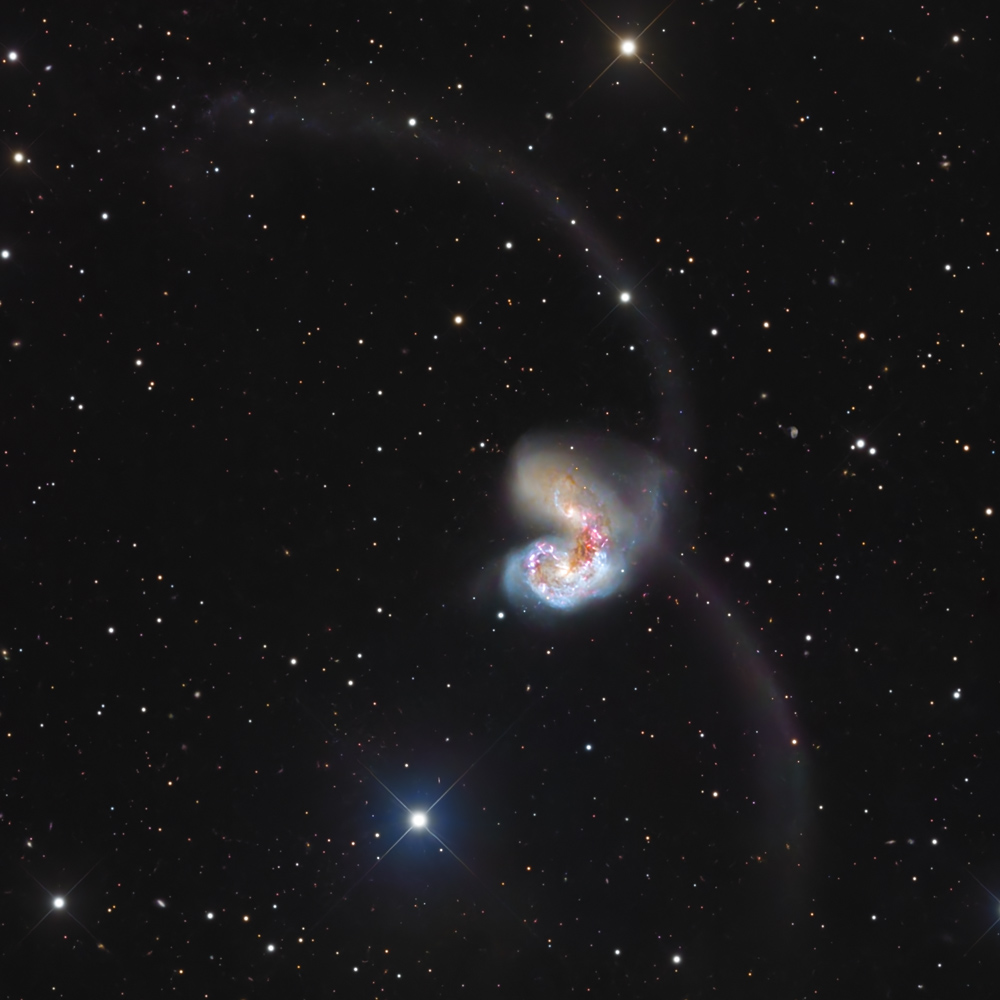
NGC 4038 and NGC 4039
Antennae Galaxies
Colliding Spiral Galaxies in Corvus

Click here for other versions: 40% uncropped (1638x1638); 65% uncropped (2662x2662); 100% cropped (2000x2000);  


NGC 4038 and NGC 4039 are a pair of spiral galaxies, in the latter stages of colliding/merging, as evidenced by the tidal tails of stars and dust emanating from the combining nuclei (these tidal tails look a bit like insect antennae; hence the name of the pair). This cosmic dance is estimated to have become a collision several hundred million years ago; this causes rapidly increased star formation in both galaxies, as evidenced by the reddish areas. This process has caused the formation of a great number of huge star clusters; most of them will get distributed among the stars of the combined galaxies as individual stars, but it is thought that the largest ones will survive as globular clusters.

Here is a computer simulation showing how the system evolved to this state.

It is located about 70 million light years from us; at that distance, the length from the tip of one tidal tail to the tip of the other is about 400,000 light years.

The entire field of the uncropped version of the photo is about the same width as a full moon.

This scene is too low in my sky to get all the detail I might get were it much higher (all images were less than 35 degrees above the horizon), but it's such a striking pait that I thought it was worth trying.


Technical Information:

HaLRGB: 400:840:180:180:220 (a total of over 30 hours of light-frame exposure time); here's a chart showing the various subexposures I used in the image:

Hydrogen Alpha: 20 twenty-minute images Luminance: 39 twenty-minute and 20 three-minute
Red: 12 fifteen-minute
Green: 15 fifteen-minute
Blue: 12 twenty-minute
The luminance layer is a HDR blend of the 20-minute images and the three-minute images. The red channel is a blend of the red data and the Ha data. The green channel is made up entirely of the green data. The blue channel is made up entirely of the blue data.


Equipment: RC Optical Systems 14.5 inch Ritchey-Chrétien carbon fiber truss telescope, with ion-milled optics and RCOS field flattener, at about f/9, and an SBIG STX-16803 with internal filter wheel (SBIG filter set), guided by an SBIG STX Guider, all riding on a Bisque Paramount ME German Equatorial Mount.

Image Acquisition/Camera Control: Maxim DL, controlled with ACP Expert/Scheduler, working in concert with TheSky X.

Processing: All images calibrated (darks, bias and sky flats), aligned, and combined in Pixinsight. Color combine in Pixinsight. Some finish work (background neutralization, color calibration, Noise XTerminater, Blur XTerminator) done in Pixinsight; some finish work (LRGB combination, contrast and saturation adjustment) was done in Photoshop CC.

Location: Data acquired remotely from Sierra Remote Observatories, Auberry, California, USA.

Date: Images taken on many nights during February, March and April of 2026. Image posted April 30, 2026.

Date: Image scale of full-resolution image: 0.56 arcseconds per pixel.

Seeing: Variable, but generally ok.

CCD Chip temperature: -25C

Copyright 2026 Mark de Regt

hosting forum
Hit Counter