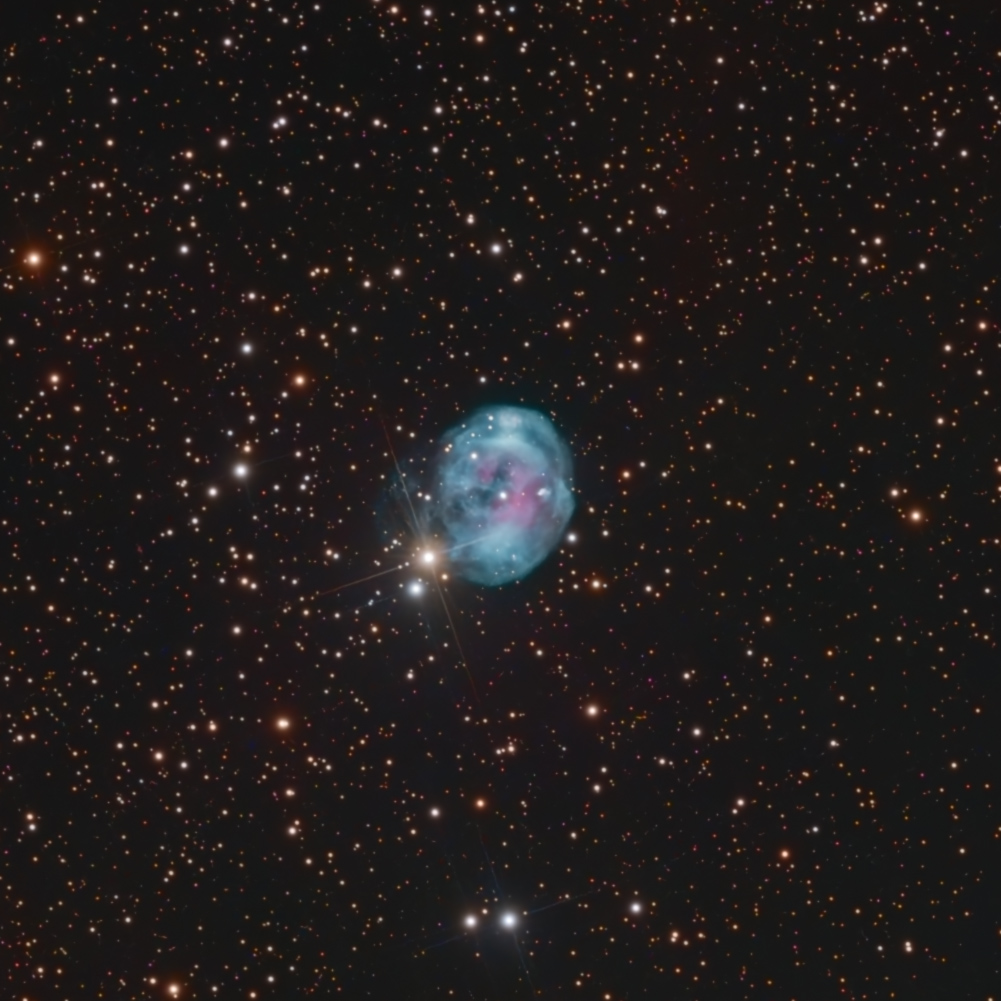
Technical Information:
(HaOIIIL)(HaR)(OIIIG)(OIIIB): Ha:OIII:L:R:G:B: 600:630:582:180:165:240 (a total of almost 40 hours of light-frame exposure time); here's a chart showing
the various subexposures I used in the image:
Hydrogen Alpha: 20 thirty-minute
Oxygen III: 21 thirty-minute
Luminance: 34 fifteen-minute, and 24 three-minute
Red: 12 fifteen-minute
Green: 11 fifteen-minute
Blue: 12 twenty-minute
The luminance layer is a mix of the luminance-filtered images, the Ha-filtered images and the OIII-filtered images; the red channel is a mix of the red-filtered images
and the Ha-filtered images; the green channel is a mix of the green-filtered images and the OIII-filtered images; the blue channel is a mix of the blue-filtered images and the OIII-filtered images.
Equipment: RC Optical Systems 14.5 inch Ritchey-Chrétien carbon fiber truss telescope, with ion-milled optics and RCOS field flattener, at about f/9, and an
SBIG STX-16803 with internal filter wheel (SBIG filter set), guided by an SBIG STX Guider, all riding on a Bisque Paramount ME German Equatorial Mount.
Image Acquisition/Camera Control: Maxim DL, controlled with ACP Expert/Scheduler, working in concert with TheSky X.
Processing: All images calibrated (darks, bias and sky flats), aligned, and combined (using NormalizeScaleGradient) in Pixinsight. Color combine in Pixinsight.
Narrow-band data blended into the luminance and color layers in Pixinsight. Some finish work (gradient correction, background neutralization, color calibration, NoiseXTerminator,
BlurXTerminator, done in Pixinsight; some finish work (LRGB combination, saturation adjustment) was done in Photoshop CC.
Location: Data acquired remotely from Sierra Remote Observatories, Auberry, California, USA.
Date: Images taken on many nights during September and October of 2025. Image posted January 26, 2026.
Date: Image scale of full-resolution image: 0.56 arcseconds per pixel.
Seeing: Variable; often good, but often not at all good.
CCD Chip temperature: -25C